

How to Choose Legal Representation That Wins
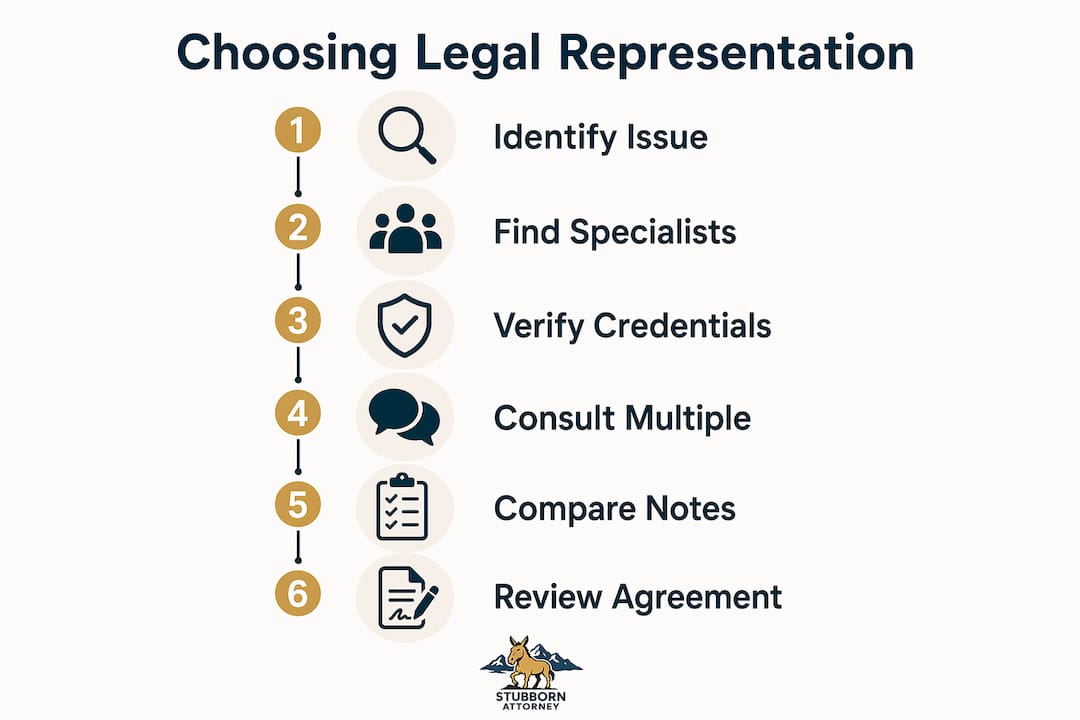
Choosing legal representation is the process of identifying and hiring the attorney best suited to resolve your specific legal issue effectively and affordably. The right choice directly shapes your outcome. The wrong one costs you time, money, and results you cannot recover. This guide gives you a clear, step-by-step process for selecting a lawyer who matches your case type, communicates honestly, and fights for you without backing down. You will learn how to define your legal issue, find qualified candidates, evaluate them in consultations, and make a confident final decision.
How to choose legal representation the right way
Legal representation is the formal term for hiring a licensed attorney to advocate on your behalf in a legal matter. The phrase “finding the right attorney” captures the same idea from a client’s perspective. Both terms describe the same critical decision. The American Bar Association defines legal representation as the relationship in which a lawyer acts as your authorized agent in legal proceedings or negotiations.

The most common mistake people make is treating this decision like a quick online purchase. Your case type determines everything. A family law attorney who handles divorces every day is not the right fit for a personal injury claim. A criminal defense lawyer is not equipped to negotiate a business contract dispute. Matching the attorney’s specialization to your exact legal issue is the single most important criterion for effective representation.
Geographic expertise matters too. Local attorneys know the judges, court procedures, and opposing counsel in your area. That familiarity translates directly into tactical advantages you cannot get from a lawyer licensed in another state. State bar associations and resources like the American Bar Association’s lawyer referral service connect you with vetted local counsel quickly.
How do you identify your legal issue and the right specialization?
The first step is separating your emotional experience from your legal objective. These are two different things, and confusing them leads to hiring the wrong attorney. Define your legal objective in a single, concrete sentence. “I need to recover compensation for injuries caused by a negligent driver” is a legal objective. “The other driver ruined my life” is an emotional statement. Only the first one guides you toward the right specialist.
Legal practice areas are distinct disciplines. The major ones include:
- Personal injury: Car accidents, slip and falls, medical malpractice, wrongful death
- Family law: Divorce, child custody, adoption, domestic violence orders
- Criminal defense: Misdemeanors, felonies, DUI, white-collar offenses
- Employment law: Wrongful termination, discrimination, wage disputes
- Estate planning: Wills, trusts, probate proceedings
- Contract and business law: Disputes, breach of contract, business formation
Each area requires years of focused practice. An attorney who dabbles in multiple unrelated fields is a warning sign, not a selling point. You want someone who handles cases like yours every week.
Online legal encyclopedias like Nolo and FindLaw provide plain-language explanations of most legal issues. State bar association websites publish guides organized by practice area. These resources help you confirm your issue category before you start contacting attorneys.
Local expertise adds another layer of value. A Colorado Springs personal injury attorney who regularly appears in El Paso County courts brings knowledge that no out-of-state firm can replicate. Court culture, local procedural norms, and relationships with opposing counsel all affect how your case moves.
Pro Tip: Prepare a written timeline of events in chronological order before your first consultation. List dates, names, and facts without editorializing. This preparation saves consultation time and helps attorneys quickly identify the actionable issues in your case.
Where and how do you find qualified attorneys?
The best starting point for finding qualified legal representation is an official referral service. State bar referral services are publicly accessible, operate during normal business hours, and connect you with vetted attorneys who often offer free 30-minute consultations. The American Bar Association’s national referral network provides the same function at a broader level.
Personal referrals from people you trust carry significant weight. A friend or colleague who had a positive outcome with a specific attorney gives you firsthand evidence of that lawyer’s communication style and results. That is more reliable than any marketing profile.
Online legal directories offer detailed filtering by practice area, location, and client reviews. The most widely used platforms include:
- Justia: Free directory with attorney profiles, practice areas, and bar admission records
- Avvo: Includes peer endorsements, disciplinary history, and client reviews with a numerical rating
- FindLaw: Organized by practice area and geography, with firm overviews and contact details
- Martindale-Hubbell: Peer-reviewed ratings used heavily in the legal industry for attorney credibility
Experts recommend interviewing at least 3–5 attorneys before making a hiring decision. That volume gives you a real basis for comparison on approach, communication style, and fees. Settling on the first attorney you speak with is one of the most common and costly mistakes in this process.
Always verify credentials beyond what you see on a marketing profile. Check official state bar disciplinary records to confirm an attorney’s license status and review any disciplinary actions or malpractice findings. Paid directory profiles do not surface this information automatically. Every state bar publishes a public search tool for this purpose.
| Resource | Type | Key Feature |
|---|---|---|
| State bar referral service | Official | Vetted attorneys, free 30-min consults |
| American Bar Association | Official | National network, practice area filters |
| Justia | Online directory | Free profiles, bar admission records |
| Avvo | Online directory | Ratings, disciplinary history, reviews |
| FindLaw | Online directory | Practice area and geography filters |
| Personal referrals | Word of mouth | Firsthand experience, communication insight |
Pro Tip: Over 65% of lawyers offer at least one free initial consultation. Consultations typically run 30–60 minutes. Always confirm whether the consultation is free and how long it lasts before you schedule. Never assume.
What questions should you ask during attorney consultations?
The consultation is your interview of the attorney, not the other way around. Clients now prioritize clear communication and relevant trial experience over firm size or name recognition. Transparency in fees and responsiveness to your questions are the baseline expectations for any attorney worth hiring.
Assess communication style from the first exchange. Does the attorney listen before speaking? Do they explain legal concepts in plain language? Do they answer your questions directly? Comfort and trust with your attorney are not soft factors. They are functional requirements. You will need to share sensitive, sometimes embarrassing details about your situation. If you feel rushed or talked down to in the first meeting, that dynamic will not improve.
Verify the attorney’s experience with cases that closely match yours. Ask specifically about outcomes, not just years in practice. An attorney with five years of focused personal injury trial experience is more valuable for your car accident case than a 20-year generalist. For personal injury matters, ask whether the attorney has taken cases to trial or settles everything. Relevant trial experience signals that the attorney is not afraid of the courtroom, which gives you leverage in settlement negotiations too.
Fee transparency is non-negotiable. The three main billing structures are hourly rates, flat fees, and contingency fees. Contingency arrangements, common in personal injury cases, mean the attorney collects a percentage of your recovery and nothing if you lose. Always clarify what a flat fee covers before signing anything. Many flat fee agreements exclude trial preparation, discovery, or appeals unless explicitly stated. Misunderstanding fee scope is a leading cause of billing disputes.
The top questions to ask during any consultation:
- How many cases similar to mine have you handled in the past two years?
- What is your assessment of my case’s strengths and weaknesses?
- What is your billing structure, and what does it include?
- Who in your office will actually work on my case day to day?
- What is a realistic timeline for resolution?
- Have you taken cases like mine to trial, and what were the outcomes?
- What do you need from me to move forward effectively?
Watch for red flags. Evasive answers to fee questions, guarantees of specific outcomes, and slow responses to your initial inquiry all signal problems. An attorney who cannot communicate clearly before you hire them will not improve after you sign.
Pro Tip: Ask the attorney to walk you through the consulting a lawyer workflow for your specific case type. Their answer reveals how organized, experienced, and client-focused they actually are.
How do you compare lawyers and make the final hiring decision?
After completing 3–5 consultations, compare your notes systematically. Relying on memory alone introduces bias toward whoever you spoke with most recently. Write down your impressions of each attorney immediately after each meeting while the details are fresh.
The factors that matter most in your comparison are specialization fit, communication quality, fee structure, and verified reputation. Use a simple comparison framework:
| Criterion | Attorney A | Attorney B | Attorney C |
|---|---|---|---|
| Specialization match | Strong | Moderate | Strong |
| Trial experience | Yes, 10+ cases | Limited | Yes, 20+ cases |
| Fee structure | Contingency, 33% | Hourly, $300/hr | Contingency, 33% |
| Communication style | Direct, clear | Formal, slow | Direct, responsive |
| Disciplinary record | Clean | Clean | Clean |
| Client reviews | 4.8/5 | 4.2/5 | 4.7/5 |
This format forces an objective side-by-side view. It also surfaces gaps you might overlook when evaluating attorneys one at a time.
Read every word of the engagement agreement before signing. The contract defines the scope of representation, the fee arrangement, and the conditions under which either party can terminate the relationship. Pay close attention to what is explicitly excluded. Understanding contingency fee arrangements before you sign protects you from surprises later.
If you have second thoughts after signing, most states allow a short window to withdraw from a legal services agreement. Check your state bar’s rules on this. Conflicts of interest are a separate issue. If you discover that your attorney previously represented the opposing party, raise it immediately. That situation may require you to find new counsel regardless of how far along the case has progressed.
Pro Tip: Fee arrangements are often negotiable, especially for cases with strong facts. Ask whether the contingency percentage changes if the case settles before trial versus after. Monitor billed hours on hourly arrangements by requesting monthly itemized statements.
What I have learned about choosing an attorney after a decade in this field
Choosing an attorney is not like hiring a contractor to fix your roof. It is closer to choosing a partner for one of the most stressful experiences of your life. I have seen clients make every mistake in this process, and the pattern is almost always the same: they rush, they skip the fee conversation, and they mistake confidence for competence.
The clients who get the best outcomes are the ones who show up prepared. They bring a written timeline. They have a clear, one-sentence description of what they need. They ask hard questions and pay attention to how the attorney responds under pressure. That preparation signals to the attorney that you are a serious client, and serious clients get serious attention.
The most common error I see is hiring the first attorney who sounds reassuring. Reassurance is easy to perform. What you need is someone who tells you the truth about your case, including the parts that are not in your favor. An attorney who only tells you what you want to hear is not protecting you. They are protecting the relationship.
Fee conversations make people uncomfortable, but skipping them is far more costly. I have watched clients sign flat fee agreements without asking what the fee covers, then face unexpected invoices when the case moved to trial. Read the contract. Ask the question. The right attorney will not be offended by it.
Patience in this process pays off. Taking two extra weeks to interview more attorneys and compare your options is not a delay. It is an investment in the outcome. A good fit is achievable. Do not settle for less because the process feels uncomfortable.
— Ryan
Stubbornattorney is ready to fight for your case
At Stubbornattorney, we offer a free initial case evaluation with no obligation. Ryan Malnar has spent over a decade representing injured victims across Colorado, and as a former federal claims adjudicator, he knows exactly how insurance companies evaluate your claim from the inside. That experience shapes every case strategy we build. We handle personal injury cases across Colorado Springs, Pueblo, Burlington, and surrounding communities. If you are dealing with a car accident, slip and fall, or another serious injury, we are the team that does not let go. Schedule your free consultation today and find out what your case is actually worth.
FAQ
What is legal representation?
Legal representation is the formal relationship in which a licensed attorney acts as your authorized advocate in legal proceedings, negotiations, or disputes. The attorney speaks and acts on your behalf within the boundaries of the law.
How many lawyers should I interview before hiring one?
Interview at least 3–5 attorneys before making a hiring decision. Comparing multiple candidates gives you a reliable basis for evaluating approach, communication style, and fees.
Are initial consultations with lawyers free?
Over 65% of lawyers offer at least one free initial consultation, typically lasting 30–60 minutes. Always confirm the fee and duration before scheduling.
How do I verify a lawyer’s credentials and disciplinary history?
Check your state bar association’s public disciplinary records database. Official bar records are the most reliable source for license status, disciplinary actions, and malpractice findings, more so than any online review platform.
What is a contingency fee and when does it apply?
A contingency fee means the attorney collects a percentage of your recovery only if you win. It applies most commonly in personal injury cases and allows clients to pursue claims without paying legal fees upfront.
Recommended
- How to Choose the Right Personal Injury Lawyer in Colorado Springs: 7 Key Questions – Malnar Injury Law
- Why Hire a Top-Rated Attorney After an Accident
- How can hiring an auto collision attorney help you win your case? – Malnar Injury Law
- Why attorneys fight insurance companies: get fair payouts in Colorado