

Colorado Spinal Cord Injury Lawsuits: A Trial Lawyer on Deadlines
If another person’s negligence caused your spinal cord injury, you can generally file a lawsuit in Colorado to recover compensation, but the clock is already running on your deadline to act. Get medical treatment first, keep every bill and record, and contact a Colorado personal injury attorney as soon as possible to protect the evidence your claim will depend on.
Table of Contents
- Legal Options After a Spinal Cord Injury in Colorado
- Common Causes, Types, and Impacts of Spinal Cord Injuries
- How a Spinal Cord Injury Lawsuit Is Built in Colorado
- Statute of Limitations and Timeline for a Colorado Claim
- How an Attorney Helps and What to Ask Before You Hire One
- Ryan Malnar and the Team Behind Our Spinal Cord Injury Cases
- What It Costs to Pursue a Spinal Cord Injury Lawsuit in Colorado
- Red Flags to Watch For When Choosing Legal Representation
- What Actually Matters Most in These Cases
- Get a Free Case Evaluation for Your Spinal Cord Injury Claim
- FAQ
- Sources
Legal Options After a Spinal Cord Injury in Colorado
The right legal theory for your case depends on how the injury happened and who was responsible. Most Colorado spinal cord injury claims fall under one of a few categories, and identifying the correct one early affects which defendants you can pursue and what evidence your attorney needs to gather right away.
- Car, truck, or motorcycle crash: Typically a negligence claim against the at-fault driver or, in commercial cases, their employer.
- Fall on someone else’s property: A premises liability claim against the property owner or manager.
- Surgical or treatment error: A medical malpractice claim against a doctor, hospital, or provider.
- Defective product or equipment failure: A product liability claim against a manufacturer or distributor.
- Fatal outcome: A wrongful death claim brought by surviving family members.
Some cases involve more than one theory at once, such as a trucking accident where both the driver and the trucking company share liability. When a government entity or public agency might be a defendant, such as a city responsible for a dangerous roadway, special notice requirements apply and shrink your timeline dramatically. That is one reason to involve an attorney before you decide how to classify your case; waiting to sort out the legal theory on your own can mean losing the chance to pursue a particular defendant altogether. You can read more about how these claims typically unfold in our overview of personal injury claims in Colorado.
Common Causes, Types, and Impacts of Spinal Cord Injuries
Spinal cord injuries in Colorado commonly result from motor vehicle accidents, falls, workplace incidents, recreational accidents on the state’s trails and slopes, and preventable medical errors. The severity and permanence of the injury shape both the medical path forward and the value of a legal claim.
Spinal cord injuries range across a wide spectrum, from incomplete injuries that preserve some sensation or movement below the injury site to complete injuries with total loss of function, according to the Mayo Clinic. The location of the injury on the spine (cervical, thoracic, or lumbar) largely determines whether a person experiences paraplegia or tetraplegia, and that distinction drives everything from daily care needs to long-term medical costs.
- Incomplete injuries may allow partial mobility or sensation but often still require extensive rehabilitation.
- Complete injuries typically mean total loss of function below the injury level and lifelong care needs.
- Cervical (neck) injuries often cause tetraplegia, affecting arms, legs, and torso.
- Lumbar and thoracic injuries more often result in paraplegia, affecting the lower body.
These physical realities translate directly into financial ones: wheelchairs, home modifications, attendant care, and lost earning capacity all follow from the severity and level of injury, which is why medical documentation becomes central to building a case.
How a Spinal Cord Injury Lawsuit Is Built in Colorado
A spinal cord injury lawsuit in Colorado rests on proving negligence, meaning your attorney has to establish four distinct elements before a court or insurer will take the claim seriously.
- Duty: The defendant owed you a duty of care, such as a driver’s duty to follow traffic laws or a property owner’s duty to maintain safe premises.
- Breach: The defendant failed to meet that duty, whether through distracted driving, ignoring a known hazard, or a surgical error.
- Causation: That breach directly caused your spinal cord injury, not some unrelated factor.
- Damages: You suffered measurable harm, medical, financial, or personal, as a result.
Colorado’s recent case law shows how closely courts scrutinize these elements. In Miller v. Crested Butte, the Colorado Supreme Court addressed whether a private release agreement could bar a negligence per se claim arising from a ski lift accident, clarifying when violations of safety statutes can still form the basis of a claim even where a waiver was signed. That kind of ruling matters for spinal cord cases involving recreational activities, waivers, or regulatory violations.
Once negligence is established, damages in a spinal cord injury case typically include past and future medical bills, lifetime attendant care costs, lost wages and diminished earning capacity, pain and suffering, and in cases involving egregious conduct, punitive damages. Because catastrophic spinal injuries often require decades of care, accurate life-care planning is one of the most consequential parts of valuing a claim, an area where the National Spinal Cord Injury Statistical Center provides widely used data on long-term rehabilitation and care needs.
Building the evidentiary record for these claims typically draws on treating physician records, formal life-care plans, vocational experts who assess lost earning capacity, accident reconstruction specialists, and independent medical examiners.
Pro Tip: Ask your treating physicians to document functional limitations in detail at every visit; vague notes make it harder to later prove the full scope of your damages.
Statute of Limitations and Timeline for a Colorado Claim
Colorado law generally gives injury victims a limited window to file a personal injury lawsuit, and that window can be shorter in specific circumstances, such as claims against a government entity or cases involving a minor. Because the exact deadline depends on the facts of your case, the only reliable way to know your true filing date is to consult a Colorado attorney promptly rather than relying on a general rule of thumb.
While the clock is running, a few immediate steps protect your claim:
- Get and continue medical treatment, even if symptoms seem to improve.
- Keep copies of every medical bill, prescription, and treatment record.
- Photograph the accident scene, your injuries, and any hazardous conditions.
- Collect names and contact information for witnesses before memories fade.
- Avoid giving a recorded statement to an insurance adjuster without counsel present.
A typical spinal cord injury case moves through investigation, medical record review, a formal demand to the insurer, negotiation, and, if a fair settlement isn’t reached, litigation. Cases with complex medical questions, multiple defendants, or disputes between insurance carriers tend to take longer, sometimes well over a year, because every party wants a clear picture of long-term prognosis before settling. Our comparative negligence guide explains one of the issues that often slows down negotiations: disputes over shared fault.
How an Attorney Helps and What to Ask Before You Hire One
A spinal cord injury claim typically requires more resources than a standard injury case. An attorney handling one of these claims usually manages the full investigation, retains life-care planners and vocational experts, negotiates directly with insurance adjusters, coordinates outstanding medical bills, and files suit when a fair settlement isn’t on the table.
When you’re evaluating a potential attorney, look for experience specific to catastrophic injuries, a demonstrated willingness to take cases to trial rather than settle quickly, the financial resources to front expert costs, and clear communication about fees and case progress. Local courtroom familiarity in Colorado also matters, since judges, opposing counsel, and insurance practices vary by jurisdiction.
Before hiring, ask the attorney directly:
- Who will personally handle my case day to day?
- How many spinal cord or catastrophic injury cases have you handled?
- Have you taken cases like mine to trial, and what were the results?
- How do you structure your contingency fee?
- Who pays for expert witnesses and medical record costs upfront?
- How often will I receive case updates, and from whom?
- What is your estimated timeline for a case like mine?
- Will you consult life-care planners or vocational experts in my case?
- How do you handle negotiations with my health insurer’s subrogation claims?
- What happens if we don’t reach a settlement I’m comfortable with?
Pro Tip: Write down the answers during your free consultation; comparing notes across two or three firms makes it much easier to spot vague or evasive responses later.
Ryan Malnar and the Team Behind Our Spinal Cord Injury Cases
Ryan Malnar has practiced personal injury law in Colorado for over a decade and previously worked as a federal claims adjudicator, experience that gives direct insight into how insurers and government agencies evaluate catastrophic injury claims from the other side of the table. That background shapes how we approach negotiations and, when necessary, litigation.
We have experience settling injury cases and pursuing recoveries for clients, working on a contingency fee basis so you pay nothing unless we win your case. For spinal cord injury claims specifically, we retain life-care planners, vocational experts, and medical specialists as needed to build the full picture of what your future care will cost. When you come in for a free case evaluation, bring whatever medical records, accident reports, and insurance correspondence you already have; it helps us start building your case immediately.
What It Costs to Pursue a Spinal Cord Injury Lawsuit in Colorado
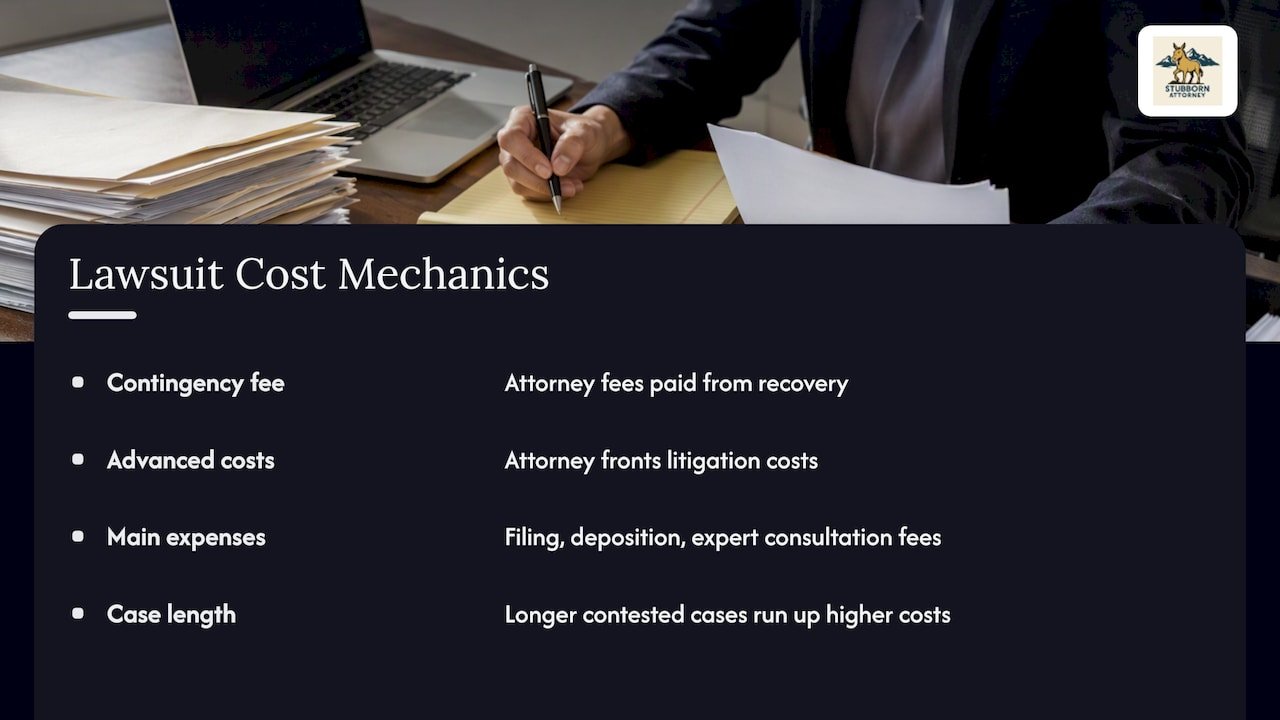
Most Colorado personal injury attorneys, including our firm, handle spinal cord injury cases on a contingency fee basis, meaning you pay attorney fees only from money recovered in a settlement or verdict, not out of pocket as the case proceeds. This structure matters enormously for catastrophic injury victims, since the upfront costs of building a strong case, including expert witnesses, medical record retrieval, accident reconstruction, and life-care planning, can run into the thousands of dollars before a case ever settles.
Under a contingency arrangement, your attorney typically fronts these litigation costs and recoups them from the final recovery, along with their fee percentage. That means your out-of-pocket risk stays low while the firm absorbs the financial risk of pursuing a complex claim. Filing fees, deposition costs, and expert consultation fees are the main expenses that accumulate as a case moves from investigation toward negotiation or trial, and a longer, more contested case naturally runs up higher costs than one that settles early.
Ask any attorney you’re considering to explain exactly how costs are advanced and deducted before you sign an agreement, since fee structures can vary in the details even when every firm calls itself “contingency based.” Our pricing structure is described on our pricing and plans page, and we will discuss details of cost advancement during a free case evaluation.
Red Flags to Watch For When Choosing Legal Representation
Not every firm that advertises personal injury services is equipped to handle a catastrophic spinal cord injury claim, and a few warning signs tend to show up before you’ve signed anything.
Be cautious of a firm that won’t tell you who will actually handle your case, since many large “case mill” operations hand off clients to junior staff or outside counsel after the initial signing. Watch for attorneys who seem reluctant to discuss trial experience or who suggest early on that your case will definitely settle, since catastrophic injury cases often require the credible threat of trial to secure a fair outcome from an insurer. A firm that can’t clearly explain how it funds expert witnesses and life-care plans upfront may lack the resources a complex spinal cord case demands.
Also be wary of pressure to settle quickly before your medical prognosis is clear, vague answers about fee structures or cost deductions, and a lack of responsiveness during your initial consultation, since that pattern often continues once you’re a signed client. Take time to compare how different firms answer the same questions; the contrast often reveals more than any single conversation.
What Actually Matters Most in These Cases
Most advice about spinal cord injury lawsuits focuses heavily on settlement size, and that emphasis misses the point for a lot of injured Coloradans. The number that matters most isn’t the headline settlement figure; it’s whether the life-care plan underneath that number actually accounts for forty or fifty years of attendant care, equipment replacement, and medical complications that haven’t happened yet.
Having sat on the other side of claims as a federal adjudicator, I’ve seen how often insurers lowball future care costs because the injured person’s own documentation didn’t anticipate decades of need. That’s the piece conventional advice underrates: choosing an attorney isn’t really about who promises the biggest number, it’s about who builds the most defensible life-care plan from day one.
If you take one thing from this guide, let it be this: protect your medical documentation obsessively from week one, because that record becomes the foundation every future dollar of your claim gets built on.
— Ryan
Get a Free Case Evaluation for Your Spinal Cord Injury Claim
We handle spinal cord injury cases across Colorado on a contingency fee basis, so you owe nothing unless we recover compensation for you. Our practice covers the full range of catastrophic injury causes, from car and truck accidents to slip and falls and medical malpractice.
Before your free case evaluation, gather your medical records, the accident report, insurance correspondence, and names of any witnesses. From there, we can tell you quickly whether you have a viable claim and what deadlines apply to your situation. Visit our personal injuries services page to get started or request your free case evaluation today.
This article is general information, not a substitute for advice from a qualified lawyer. Consult a qualified legal professional about your own circumstances before acting on anything here.
FAQ
How serious is a spinal cord injury?
Spinal cord injuries range from incomplete, where some function remains, to complete, where all sensation and movement below the injury site is lost, according to the Mayo Clinic. Even incomplete injuries often require extensive rehabilitation and can permanently affect mobility, independence, and earning capacity.
How bad does an injury have to be to sue?
You don’t need a specific severity threshold to sue; you need to show that another party’s negligence caused measurable harm, whether that’s medical bills, lost wages, or pain and suffering. Spinal cord injuries, given their long-term care needs, almost always qualify as damages serious enough to pursue through a negligence claim.
What is the statute of limitations for bodily injury claims in Colorado?
Colorado sets a general filing deadline for personal injury claims, but the exact window can shrink significantly for claims against government entities or in cases involving minors. Because missing a deadline can permanently bar your claim, it’s important to consult a Colorado attorney promptly to confirm the specific timeline that applies to your case.
How much is a lumbar spine injury worth?
There’s no fixed value for a lumbar spine injury since compensation depends on severity, required treatment, lost income, and long-term care needs documented through medical records and life-care planning. A thorough case built on complete documentation, including input from vocational and medical experts, generally reflects the true cost of the injury far better than a generic estimate.
Sources
- Spinal cord injury – Symptoms and causes – Mayo Clinic
- NSCISC – National Spinal Cord Injury Statistical Center
- Miller v. Crested Butte, LLC (Colo. 2024) — Justia