

Why Report an Accident Immediately: Your Legal Guide
Reporting an accident immediately is the single most effective action you can take to protect your insurance claim, your legal rights, and your financial recovery after a crash. The formal term for this obligation is “prompt notice,” and it appears in virtually every auto insurance policy as a contractual requirement. Fail to meet it, and your insurer can deny your claim outright. Colorado law adds another layer: state statutes require drivers to report accidents involving injuries or property damage above specific thresholds to law enforcement. Understanding why report an accident immediately matters is not just reassuring. It is the foundation of every successful personal injury case.
Why report an accident immediately: timing, law, and insurance
“Immediately” has a legal meaning that most drivers underestimate. Insurers interpret reasonable reporting time as days, not weeks. Courts have upheld claim denials when policyholders waited even a few weeks before notifying their carrier, ruling that the delay prejudiced the insurer’s ability to investigate.
The legal doctrine at play is called the notice-prejudice rule. Under this rule, an insurer can deny a claim if late notice caused it measurable harm, such as lost evidence or unavailable witnesses. Some states have weakened this rule to protect policyholders, but Colorado courts still weigh whether the delay damaged the insurer’s investigation. Reporting promptly removes that argument entirely.

Police reporting follows a separate timeline. State laws mandate that drivers file a report when an accident involves injuries or property damage above a set dollar threshold. In Colorado, that threshold is low enough that most crashes qualify. Failing to call 911 at the scene does not eliminate your obligation. You may still need to file a written report with the Colorado Department of Revenue within a set number of days.
The gap between police reporting and insurance reporting trips up many accident survivors. Calling 911 satisfies your legal duty to the state. Calling your insurer satisfies your contractual duty to your carrier. Both are required, and neither substitutes for the other.
Pro Tip: Contact your insurance company the same day as the accident, even if you are not sure who was at fault. A brief call to open a claim costs nothing and protects your coverage.
Here is a quick reference for the two reporting tracks:
- Police report: Required at the scene when injuries occur or damage exceeds state thresholds. File a written report with the state DMV if no officer responds.
- Insurance notice: Required within days per your policy language. Most carriers ask you to report “as soon as practicable.”
- Written demand or claim: Separate from notice. This comes later, after you have documented injuries and damages.
- Statute of limitations: Colorado gives most personal injury claimants three years to file a lawsuit, but this does not extend your insurance notice deadline.
How immediate reporting preserves crucial evidence
The first 30 minutes after a crash are the most valuable window you have for building your case. Most independent witnesses leave the accident scene within 5 to 10 minutes. Once they are gone, their accounts become harder to obtain and easier for the opposing party to challenge.
Evidence degrades fast. Skid marks fade. Debris gets cleared. Traffic camera footage gets overwritten, sometimes within 24 to 72 hours. A witness who saw the other driver run a red light may be impossible to locate a week later. Every hour you wait is an hour the physical record of what happened gets weaker.
Here is the order of evidence collection that matters most in the first 30 minutes:
- Photograph the scene. Capture all vehicle positions, damage, road conditions, traffic signs, and any visible injuries before vehicles are moved.
- Get witness contact information. Name, phone number, and email. Do not rely on the police to collect this for you.
- Document the other driver’s information. License, registration, insurance card, and license plate number.
- Note environmental conditions. Time, weather, lighting, and road surface. These details support or refute fault arguments later.
- Request a police report number. Even if the officer does not stay long, get the report number so you can obtain the full report later.
A police report carries special weight in insurance negotiations. It is an official government document created by a neutral third party at the scene. Adjusters treat it as the baseline account of what happened. Without one, your version of events competes directly against the other driver’s version, with no neutral record to anchor the dispute.
Key fact: The first 30 minutes post-accident are the most critical period for preserving evidence. Witnesses depart, physical evidence shifts, and digital footage gets overwritten. Acting within this window is not optional if you want a strong claim.
Gathering accident evidence thoroughly in those first minutes can be the difference between a settled claim and a denied one.
What happens when you fail to report an accident promptly
The consequences of delayed or missing accident reports fall into three categories: insurance, administrative, and criminal. Each carries real financial and legal risk.
| Consequence type | What triggers it | Potential outcome |
|---|---|---|
| Insurance claim denial | Late notice to your carrier | Full denial of repair, medical, and liability claims |
| Administrative penalty | Failure to file state accident report | License suspension, fines, points on driving record |
| Criminal charge | Leaving the scene of an injury accident | Misdemeanor to felony, depending on injury severity |
| Civil liability | No documentation of fault | Difficulty defending against inflated claims by other party |
Delayed or missing reports are a leading reason insurers deny claims. The denial is not always about fault. It is about the carrier’s ability to investigate. When you wait weeks to report, the insurer argues it could not inspect the vehicles, interview witnesses, or review the scene. That argument holds up in court more often than most people expect.
Criminal exposure is the consequence that surprises accident survivors most. Failing to report accidents involving injuries or damages above state thresholds can result in criminal penalties ranging from administrative fines to prison time for serious hit-and-run cases. Colorado treats leaving the scene of an injury accident as a class 1 misdemeanor at minimum. If the victim suffers serious bodily injury, the charge escalates to a felony.
The civil side is equally damaging. Without a prompt report, you lose the ability to control the narrative. The other driver files first, frames the facts in their favor, and you spend the rest of the claim fighting uphill. Prompt reporting keeps your coverage intact and prevents the complications that come from incomplete documentation.
Steps to take immediately after a car accident
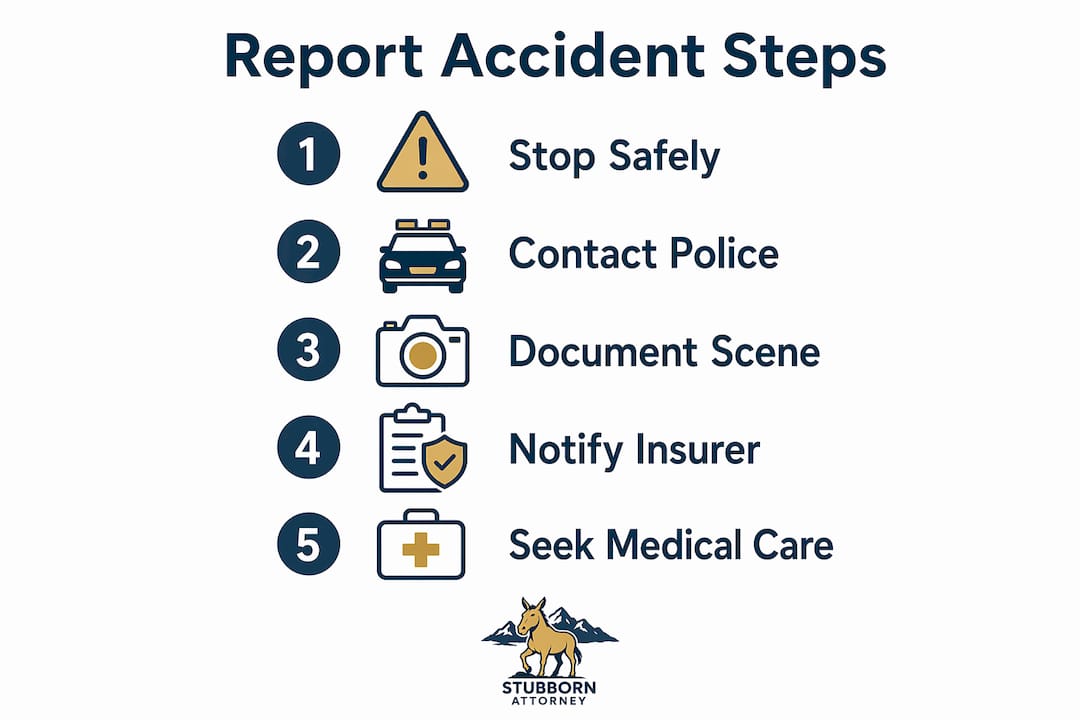
The steps you take in the first hour after a crash determine the strength of every claim and legal action that follows. Follow this sequence without skipping steps, even if the accident seems minor.
- Check for injuries first. Assess yourself and all passengers. Call 911 if anyone is hurt, unconscious, or complaining of pain. Do not move injured people unless there is immediate danger.
- Move vehicles if safe. In Colorado, drivers are required to move vehicles out of traffic when it is safe to do so. Turn on hazard lights immediately.
- Call 911. Request police and emergency medical services. A police report is your most important piece of documentation. Filing a police report is legally required for accidents with injuries or damages above state thresholds.
- Exchange information. Collect the other driver’s name, license number, insurance company, policy number, vehicle registration, and license plate. Get the same from all other involved drivers.
- Talk to witnesses now. Ask for names and contact details before they leave. Offer your contact information in return.
- Document everything. Photograph all vehicles, the road, traffic signs, skid marks, and any visible injuries. Take a short video walking around the scene.
- Notify your insurer the same day. Major carriers advise prompt reporting even for minor accidents to maintain coverage and avoid denied claims. Call your insurance company before you go to sleep that night.
- Seek medical evaluation within 24–72 hours. Even if you feel fine, get checked. Symptoms of whiplash and internal trauma often appear days later.
Pro Tip: Do not give a recorded statement to the other driver’s insurance company without speaking to an attorney first. You are not legally required to provide one, and refusal cannot be used as sole grounds to deny your claim. Adjusters are trained to ask questions that minimize payouts.
One step most people skip is documenting their own physical condition at the scene. Take a photo of any visible marks, bruises, or cuts immediately. Courts and adjusters give significant weight to contemporaneous photographic evidence of injury. A photo taken an hour after the crash is far more credible than one taken three days later.
For a complete breakdown of what to do in Colorado specifically, the post-accident steps guide covers state-specific requirements in detail.
Why early medical evaluation strengthens your accident report
Injuries from car accidents are not always visible at the scene. Seeking medical evaluation within 24 to 72 hours after an accident is essential to document injuries that are not immediately apparent, such as whiplash or internal trauma. Adrenaline masks pain. Soft tissue injuries, concussions, and internal bleeding can take days to produce symptoms.
“The gap between feeling fine at the scene and waking up in serious pain two days later is one of the most common patterns I see in personal injury cases. By then, the insurer is already questioning whether the accident caused the injury at all.”
Medical records created within 24–72 hours of the crash establish a direct timeline between the accident and your injuries. That timeline is the backbone of your personal injury claim. Without it, the opposing insurer will argue that your injuries came from a different event or a pre-existing condition. Early treatment closes that argument before it opens.
The type of provider matters too. An emergency room visit, urgent care record, or same-day appointment with your primary care physician all create official documentation. A chiropractor visit three weeks later, with no earlier records, gives the insurer room to dispute causation. The importance of prompt medical treatment after an accident goes beyond your health. It directly shapes the dollar value of your settlement.
Early medical evaluation also affects the legal strength of your case if it goes to litigation. Juries and judges look at the gap between the accident date and the first medical visit. A long gap signals doubt. A short gap signals credibility. Treating within the first 24–72 hours tells the clearest possible story: you were hurt, you recognized it, and you acted.
What I have learned from a decade of accident cases
After more than ten years handling personal injury cases in Colorado, the pattern I see most often is not dramatic. It is ordinary people who waited a few days to report because the accident seemed minor, or because they did not want to deal with the insurance company right away. That delay costs them.
The mistake I see most is people assuming that “nothing happened” at the scene means nothing will happen later. A fender bender at low speed can still produce a herniated disc. A driver who seemed fine can later claim serious injury and file against you. If you did not report promptly, you have no contemporaneous record to defend yourself with.
The notice-prejudice rule is the legal mechanism that turns delay into denial. I have watched insurers use it successfully against clients who waited even ten days to report. The insurer does not need to prove the delay caused massive harm. It only needs to show that the investigation was compromised. Ten days is enough for a witness to forget details, for a vehicle to be repaired, and for surveillance footage to be deleted.
My advice is the same every time: report the same day, see a doctor within 24 hours, and do not speak to the other party’s insurer without counsel. Those three actions protect you from the vast majority of claim complications I see in practice. The clients who follow all three steps consistently get better outcomes than those who do not. That is not a theory. It is what the case files show.
— Ryan
Stubbornattorney is ready to help you report and recover
If you have been in a car accident in Colorado, the team at Stubbornattorney knows exactly what the insurance companies are looking for and how to make sure your claim holds up. Ryan Malnar spent years as a federal claims adjudicator before becoming a personal injury attorney. That background means Stubbornattorney understands how insurers evaluate claims from the inside. A free personal injury case review takes less than an hour and gives you a clear picture of your rights and options. You can also review common personal injury case examples to see how cases like yours have been handled. Stubbornattorney represents only injured victims, and the firm does not back down.
FAQ
Why report an accident immediately instead of waiting?
Insurers interpret “prompt notice” as days, not weeks. Waiting even a short time gives your carrier grounds to deny your claim by arguing the delay harmed its ability to investigate.
What is the deadline to report a car accident in Colorado?
Colorado law requires drivers to report accidents involving injuries or significant property damage to law enforcement at the scene. Your insurance policy typically requires notice “as soon as practicable,” which courts interpret as within days.
Can I be denied coverage for reporting late?
Yes. Under the notice-prejudice rule, an insurer can deny your claim if late reporting compromised its investigation. Filing the same day removes that risk entirely.
Do I have to give a recorded statement to the other driver’s insurer?
No. You are not legally required to provide a recorded statement to the other party’s insurance company, and that refusal cannot be used as the sole grounds to deny your claim.
How does early medical care affect my accident claim?
Medical records created within 24–72 hours of the crash establish a direct link between the accident and your injuries. Without that early documentation, insurers can argue your injuries came from a different cause or a pre-existing condition.